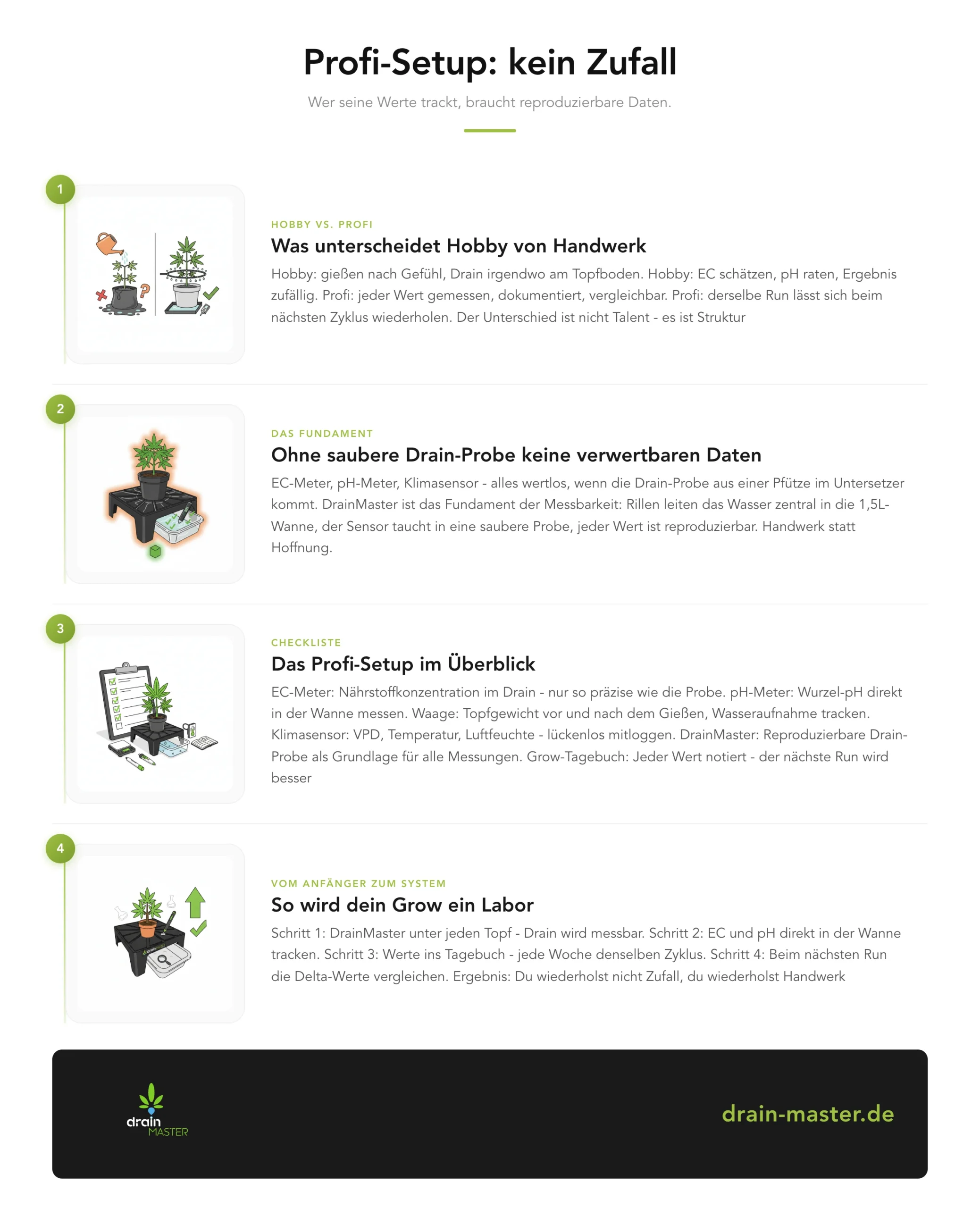
If you track your values, you need reproducible data.
More fertilizer, more yield? The biggest myth about watering
Hand on heart: You bought expensive fertilizer, the feeding chart is ready, and you think: “A little extra can’t hurt. More food, fatter buds.” This logic is widespread in hobby growing. You water when the soil looks dry and fertilize by feel or rigidly by the chart. The goal is clear, but the path is often flying blind. Watering becomes a pure supply routine, not a craft.
The problem with this approach? You only see the consequences when it’s often too late. Leaf tips turn brown and claw downward—a classic nutrient burn. Or worse: The plant shows deficiency symptoms even though you’re fertilizing like a champion. That’s called nutrient lockout, a blockage of the roots from too many salts. Instead of vigorous growth, you harvest frustration, stagnant plants, and ultimately a result that has more to do with chance than skill. You spend money on fertilizer that harms your plant more than it helps.
Why the EC value in water is the true speedometer of your grow
Let’s debunk the myth with facts. The tool that banishes chance from your grow room is an EC meter. The EC value (Electrical Conductivity) measures the electrical conductivity of your water. Sounds technical, but it’s quite simple: The more salts—meaning fertilizer—dissolved in the water, the better it conducts electricity and the higher the EC value. This value is the key to understanding what your plant really needs. It’s your direct line into the root zone.
The critical point, however, is not the EC value you pour into the plant (input EC). The real magic lies in the difference between what goes in and what comes out the bottom (drain EC). This difference, the delta, is your plant’s direct feedback. It tells you unmistakably whether you’re fertilizing too much, too little, or just right:
- Drain EC rises sharply (e.g., input 1.6, drain 2.2): Your plant is taking up fewer nutrients than you’re giving it. Salts accumulate in the substrate. Warning: overfertilization and lockout are imminent. You should reduce the fertilizer amount or water with plain water next time.
- Drain EC drops sharply (e.g., input 1.6, drain 1.1): Your plant is hungry! It’s consuming more nutrients than are contained in the nutrient solution. You can carefully increase the fertilizer concentration at the next watering.
- Drain EC is only slightly higher than input EC (e.g., input 1.6, drain 1.7-1.8): Perfect! You’re feeding your plant exactly right. There’s enough nutrition available, but no harmful accumulation is occurring.
With this information, you act proactively. You no longer wait for yellow leaves or burned tips but adjust the feeding before problems even become visible. If you want to dive deeper into the subject, this article is a good starting point to learn how to measure EC value in drain and reliably detect overfertilization.
Craft instead of hope: No clean sample, no true data
The best theory and the most expensive measuring device are worthless if your measurement basis is corrupted. And this is exactly where most growers make the critical mistake. They water their plant, wait until a puddle has formed in the saucer, and stick their EC meter in. The result is pure gambling.
Why? In the saucer, water evaporates, concentrating the salts and artificially driving the EC value up. Old fertilizer residues and deposits mix with the fresh sample. The measurement is simply unusable. You’re making decisions based on false data—it’s like driving a car with fogged-up glasses.
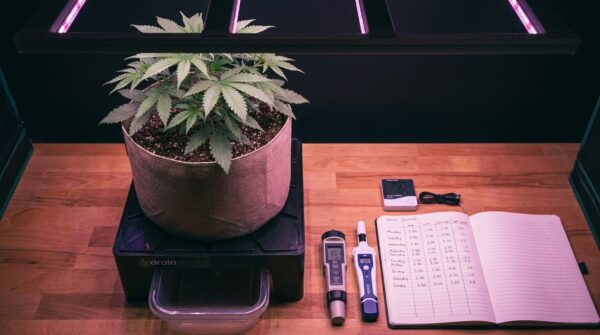
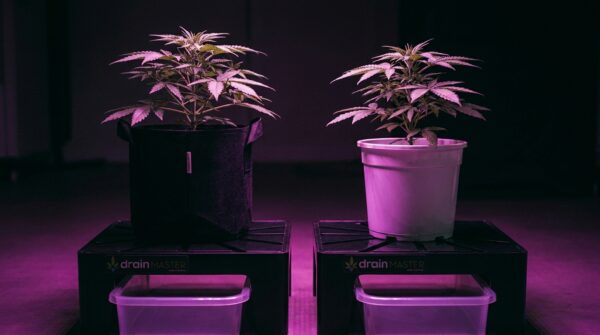
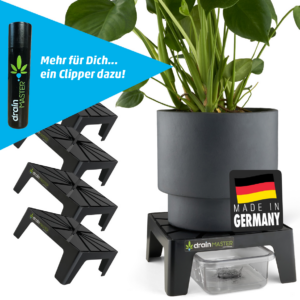
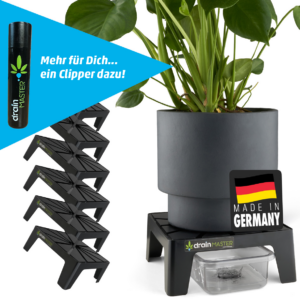
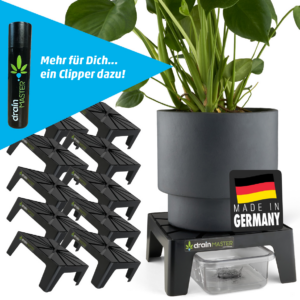
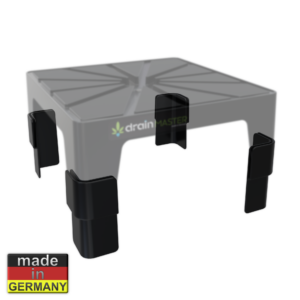
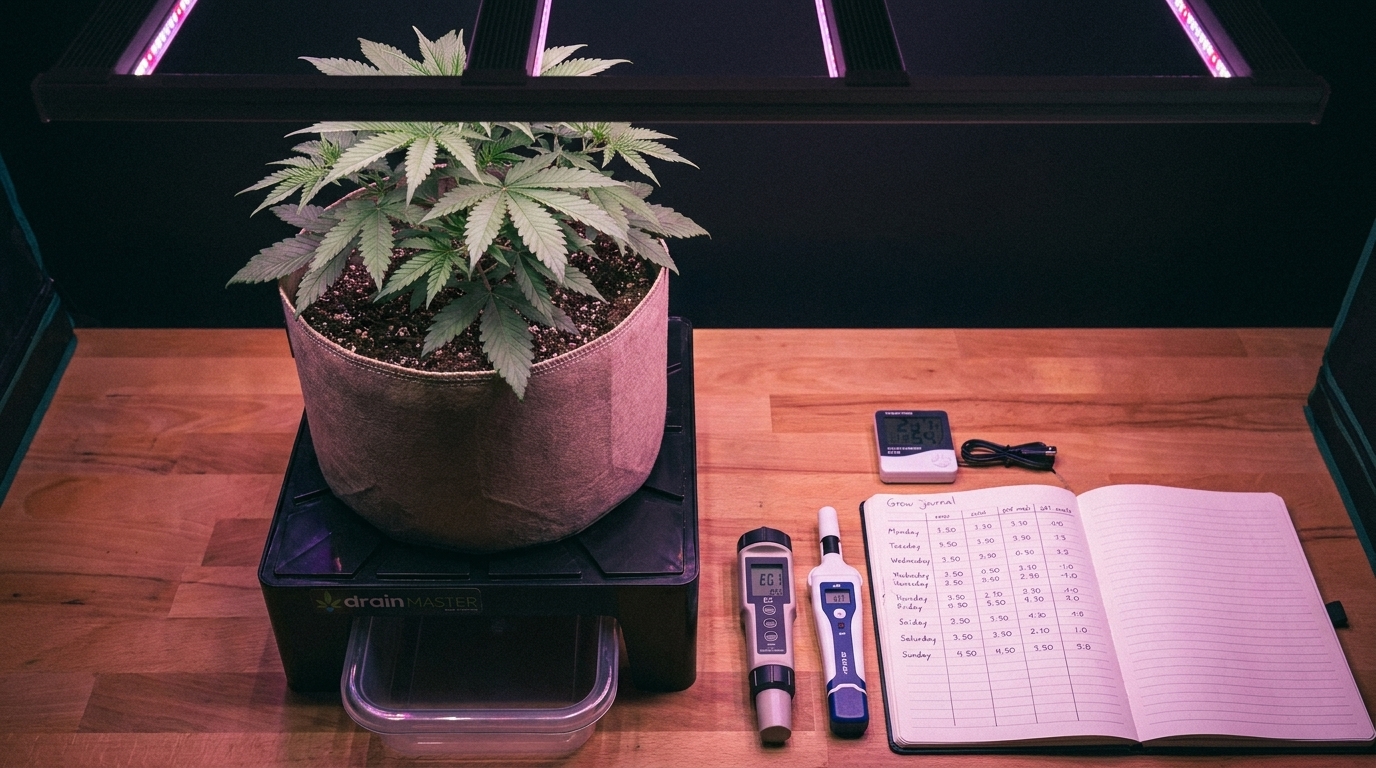
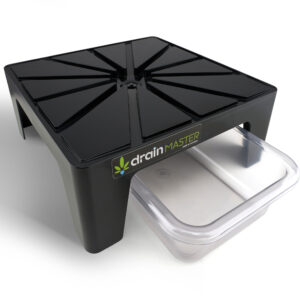
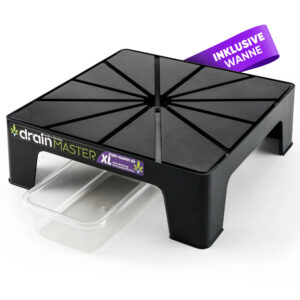
The solution is simple but critical: You need a clean, fresh drain sample collected directly from the pot before it contacts anything. Only then do you get reproducible, honest data. A system like the DrainMaster was developed precisely for this purpose. It’s not a gimmick but the foundation for data-driven watering. It collects the drain specifically and cleanly, so you finally get values you can rely on. This makes it possible to measure pH and EC values stress-free, without having to lift heavy pots.
From watering-can principle to data-driven system
When you start working with clean data, you transform your entire approach. You stop guessing and start steering. For this, you need a small but refined setup that consists of more than just a measuring device. It’s a system designed to make your grow measurable, repeatable, and therefore optimizable.
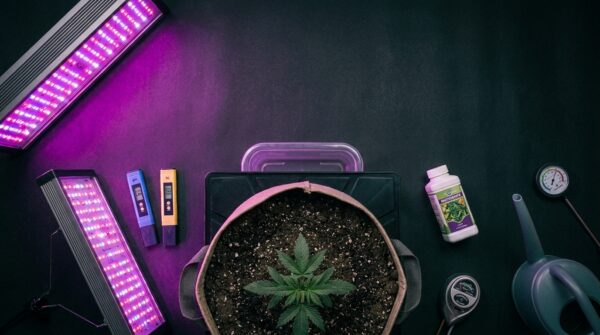
Your pro setup at a glance:
- ✅ High-quality EC/pH combo meter: Don’t cut corners here. A reliable device like the Apera EC60 Premium EC meter is an investment that pays for itself through healthy plants and better yields. Electrical conductivity is a precise physical quantity that you should measure precisely.
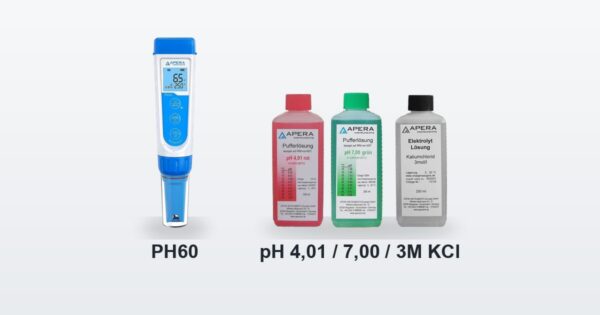
- ✅ Calibration solutions: Your meter is only as accurate as its last calibration. Without an Apera EC calibration solution, your readings are estimates at best. Calibrate regularly, at least once a month.
- ✅ A precise scale: Solid fertilizers or additives must be weighed exactly.
- ✅ Clean measuring cups & pipettes: For clean handling of your nutrient solution.
- ✅ A grow journal: Digital or paper doesn’t matter. Record date, input EC/pH, drain EC/pH, and your observations. Only this way will you recognize patterns and learn from each cycle.
With this setup, you establish an optimization loop that transforms you from hobbyist to true craftsman. Your workflow then looks like this:
- Mix nutrient solution & measure input: You mix your fertilizer and set the EC and pH values precisely.
- Water & collect clean drain: You water your plants slowly and evenly until about 15-20% of the watering volume arrives as drain at the bottom.
- Measure drain EC/pH: You take your clean sample and measure the values.
- Document values: You enter all numbers in your logbook.
- Adjust: Based on the difference between input and drain, you decide what the next nutrient solution must look like. If the drain EC is too high, you may need to flush; if it’s too low, you give a bit more.
This process is the critical step away from reactive problem-fixing toward proactive plant steering. You not only maximize the genetic potential of your strains but also save fertilizer, avoid plant stress, and ultimately achieve a quality you can taste and see. It’s the shift from hope to knowledge.