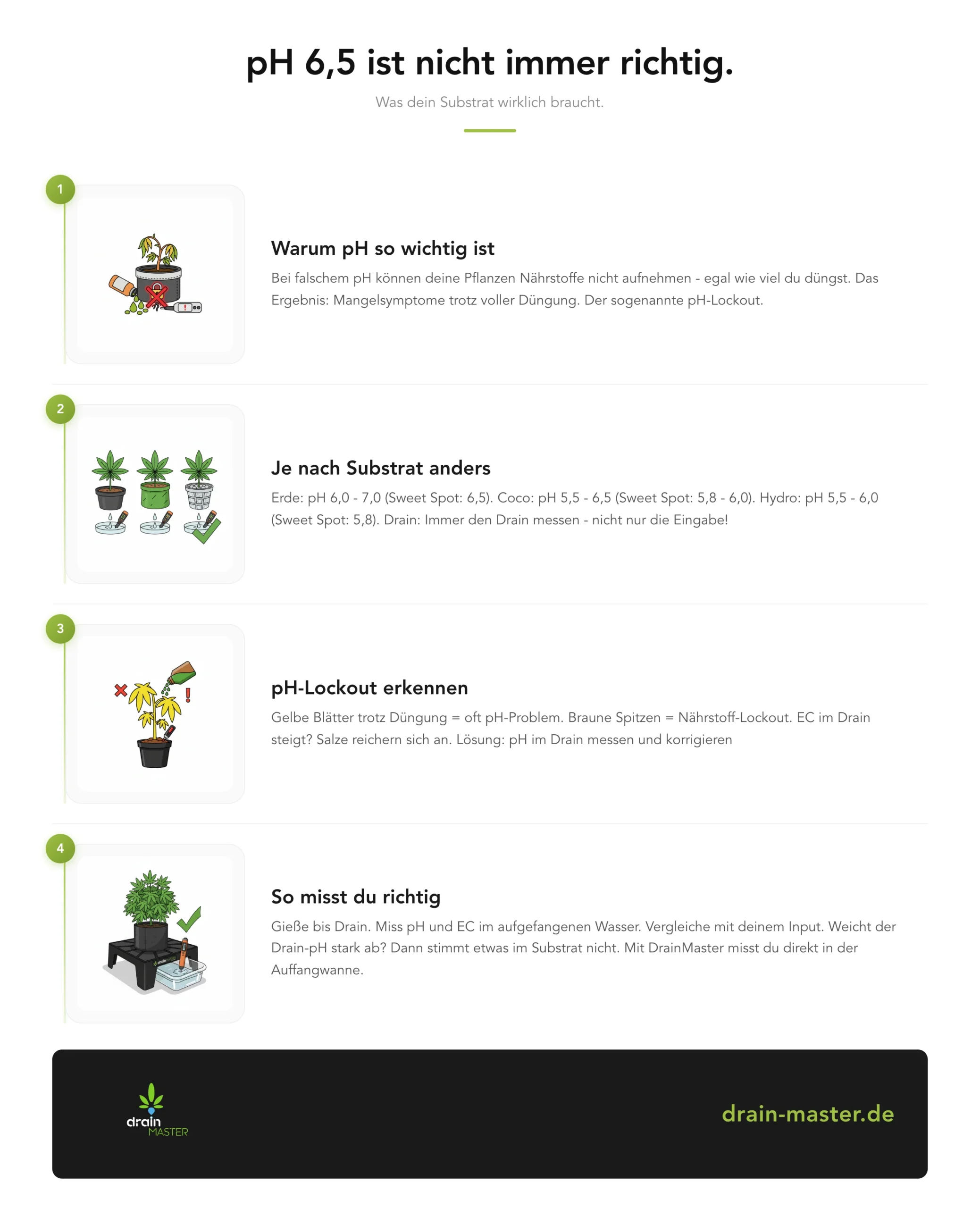
What your substrate really needs.
Adjusting the Optimal Cannabis pH Value is perhaps the most important skill that distinguishes an ambitious home gardener from a true professional. You can have the best genetics, the strongest light, and the most expensive fertilizer – if the pH value is not right, your plants will still show deficiency symptoms. It is the foundation on which everything else is built. Many growers only focus on the pH value of the irrigation water, but the real magic lies in understanding and controlling what happens in the substrate itself.
Why the Wrong pH Value Starves Your Plants
Imagine your plant sitting at a richly set table but unable to eat. This is exactly what happens with an incorrect pH value. It’s frustrating to see deficiency symptoms even when fertilizing according to plan. The culprit is almost always an unbalanced pH value in the root zone.
The Nutrient Sluice: How an Incorrect pH Value Blocks Uptake
The pH value determines the chemical form and thus the availability of nutrients in the substrate. It can be thought of as a kind of sluice for the roots. Each nutrient element, such as nitrogen, phosphorus, calcium, or iron, has a specific pH window in which it can be best absorbed by the plant. If the value is outside this window, the nutrients are physically present in the substrate but chemically “locked.” The roots simply cannot absorb them, no matter how much fertilizer you add. For example, a pH value that is too high blocks the uptake of iron and manganese, leading to the typical yellow leaves on young shoots. A value that is too low can make the uptake of calcium and magnesium difficult. Keeping the optimal cannabis pH value thus opens all the sluices for complete nutrition.
pH Lockout: When Fertilizing Worsens the Problem
This is where most beginners make the critical mistake. They see a cannabis nutrient deficiency and their reaction is: more fertilizer. But if the cause is an incorrect pH value, this leads to a “nutrient lockout.” The unused nutrients accumulate as salts in the substrate. This salt buildup in substrate increases the total salt content, which we measure as EC value. This dramatically worsens the situation: the roots are damaged by the high salt concentration (nutrient burn), which further reduces their ability to absorb water and nutrients. So you’re literally fertilizing your plant to death while it’s starving.
pH 6.5 Is Not Enough: Finding the Optimal Cannabis pH Value for Your Substrate
The blanket statement “pH 6.5 is perfect” is a dangerous oversimplification. The ideal pH range depends crucially on your growing medium. What works in soil can cause a catastrophe in a hydroponic system. Precision is the key to success here.
Soil – The Forgiving Buffer (pH 6.0 – 7.0)
Soil is ideal for beginners because it has a natural buffering effect. Microorganisms and organic matter help stabilize the pH value and compensate for minor fluctuations in the irrigation water. The optimal range here is between 6.0 and 7.0. Within this window, you should allow the value to fluctuate slightly, because not all nutrients are optimally available at exactly the same pH value. Watering with pH 6.2 and the next time with pH 6.8 ensures that the plant has access to the entire nutrient spectrum. The “sweet spot” is often around 6.5, but flexibility is an advantage here.
Coco & Hydro – Precision is Key (pH 5.5 – 6.5)
Inert media like coco fiber (coco) or hydroponic systems contain no nutrients and have virtually no buffering capacity. You are 100% responsible for nutrition, and the system reacts immediately to any change. Here, the optimal pH range is narrower and lies in the slightly acidic range of 5.5 to 6.5. The absolute “sweet spot” for maximum availability of most nutrients is between 5.8 and 6.0. Deviations show up extremely quickly in these systems, so daily monitoring is mandatory. Keeping the optimal cannabis pH value stable here is crucial for yield.
From Seedling to Bloom: Adapting to the Life Stage
Experienced growers even adjust the pH value to the plant’s life stage. In the vegetative phase, where a lot of nitrogen is needed, a slightly lower pH value can be advantageous. In the flowering phase, the need for phosphorus and potassium increases. Since phosphorus is better available at a slightly higher pH value (e.g., 6.2 in coco, 6.7 in soil), a slight upward adjustment can be useful to maximize flower formation.
Diagnosis in the Drain: How to Correctly Identify and Measure pH Problems
Your plants speak to you. You just have to learn to interpret their signals correctly. Yellow leaves are not always a simple deficiency, but often a cry for help from the root zone.
Your Plant’s Warning Signs: Interpreting Yellow Leaves and Brown Tips
A classic sign of a pH problem is interveinal chlorosis – yellow leaves with green veins, usually on the upper, young shoots. This practically screams iron deficiency, which is almost always caused by a pH value that is too high. Burnt, brown leaf tips and dark green leaves that curl downwards like claws (“eagle claws”) indicate nutrient burn, caused by an excessively high EC value and a probable lockout. Do not ignore these signs; they are your early warning.
The Truth is in the Drain: Why Runoff is More Important Than Input
Measuring only the pH of your irrigation water is like driving a car and only looking at the fuel tank, but never at the engine. The crucial information is what is happening in the substrate. And you find that out by measuring the runoff water (drain or runoff). The procedure for measuring runoff is simple:
- Mix your nutrient solution and measure the pH and EC values (input).
- Water your plant slowly and evenly until about 15-20% of the water runs out of the bottom of the pot.
- Collect this drain water and measure its pH and EC values (output).
Comparing input and output gives you an exact picture of the condition of your root zone.
What the EC Value in the Drain Reveals
The drain EC value is your best indicator of nutrient uptake. If the runoff EC value is significantly higher than that of your irrigation water, salts are accumulating. The plant is not consuming what you are serving it. The solution is to lower the EC value of the nutrient solution or flush the substrate with pH-regulated water. If the EC value in the drain is lower than the input, the plant is hungry, and you can carefully increase the fertilizer concentration. The ideal state is when the EC value in the drain is only slightly above that of the input.
Growing cannabis legally in 2026: The complete guide
Start your outdoor grow: Guide for balcony & garden
From Measuring to Mastering: Actively Controlling pH and Preventing Problems
Reacting is good, acting is better. With regular monitoring of your drain, you can solve problems before they even become visible. A stable root environment is the key to healthy plants and maximum yields.
How to Effectively Correct the pH Value in the Substrate
If the drain measurement reveals a problem, don’t panic. Correction happens slowly and over several watering cycles. If the drain pH deviates significantly, adjust the pH of your next irrigation solution specifically. For example, if the drain pH in soil is 5.5, water next time with a pH of 7.0 to gently raise the value in the substrate. Radical flushing is only necessary for extreme nutrient burn (very high EC). A stable optimal cannabis pH value in the substrate is achieved gradually, not by force.
Make Monitoring a Routine: Drain Measurement Made Easy
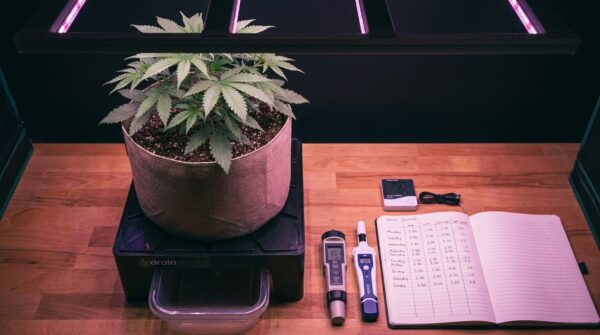
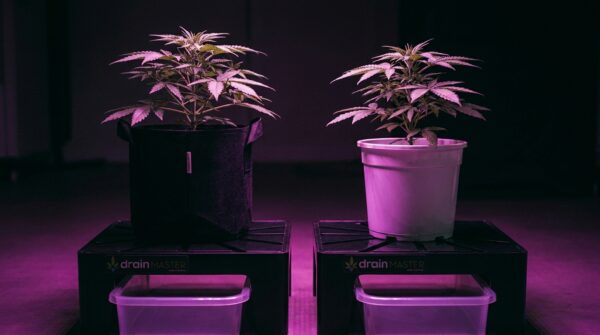
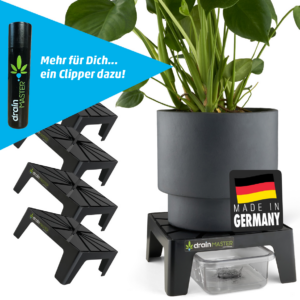
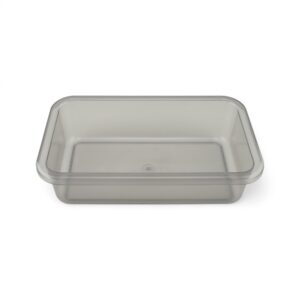
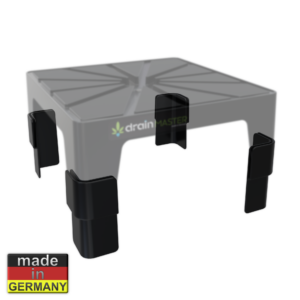
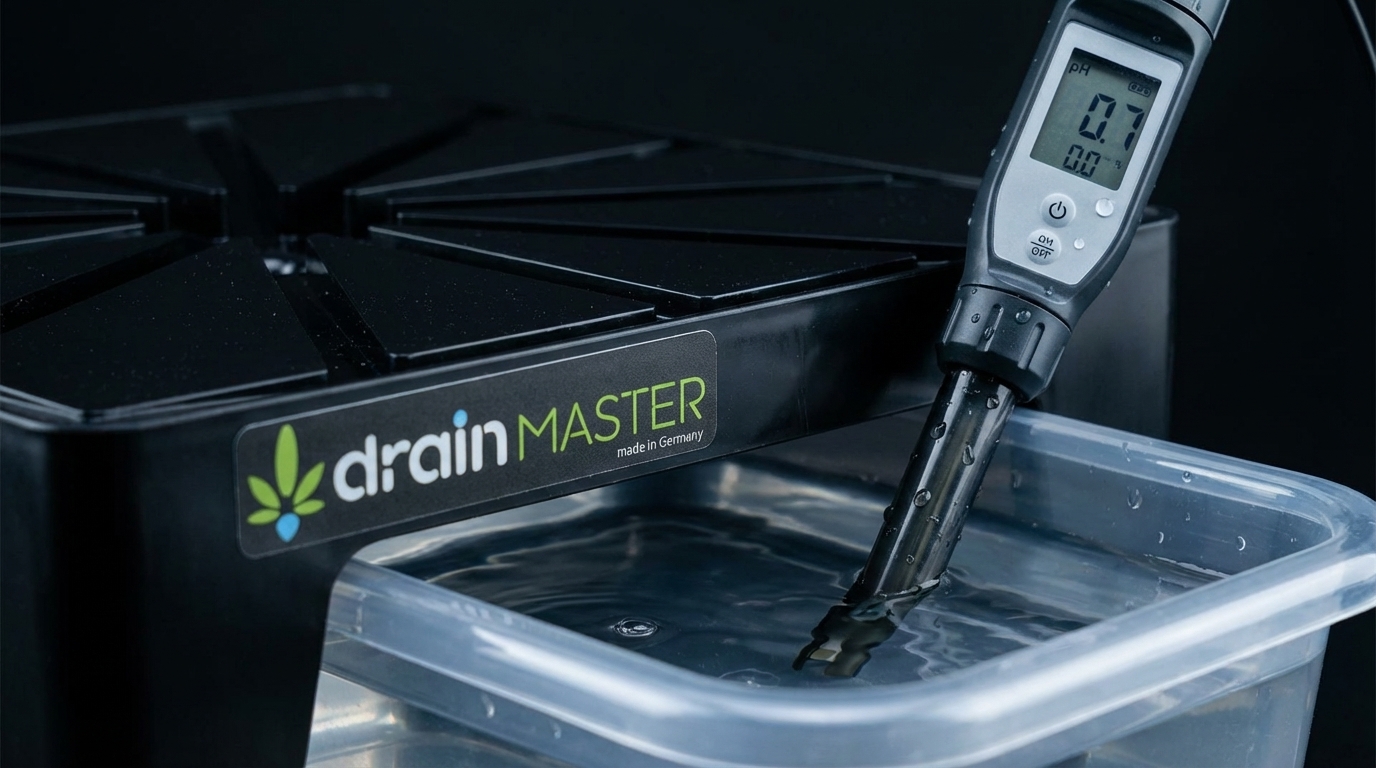
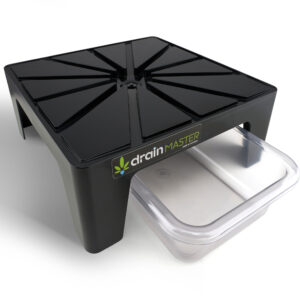
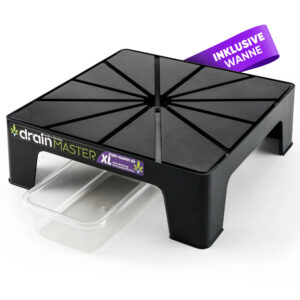
The key to success is consistency. Make drain measurement a fixed part of your routine, at least once a week. This prevents the dreaded salt buildup in substrate and allows you to perfectly tailor your feeding schedule to your plant’s needs. This ensures that your cannabis pH value remains optimal. Tools like the DrainMaster – a mini drainage tray made from ASA plastic like those used in the automotive industry, made in Germany, manufactured with 100% green electricity and our own PV system – make this crucial step enormously easier. Instead of lifting the pot or handling saucers, the integrated transparent 1.5 L tray catches the drain directly. You simply place your measuring device directly in the tray and read pH and EC in relation to the input – in seconds instead of minutes. Precise control has never been this easy.