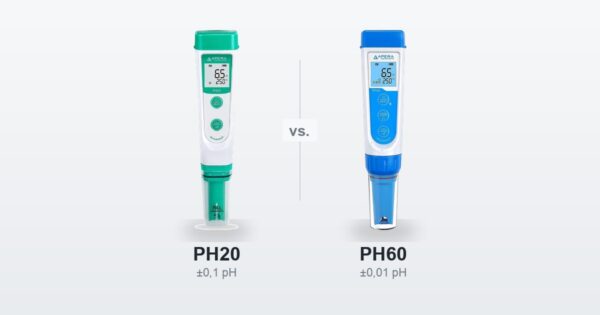
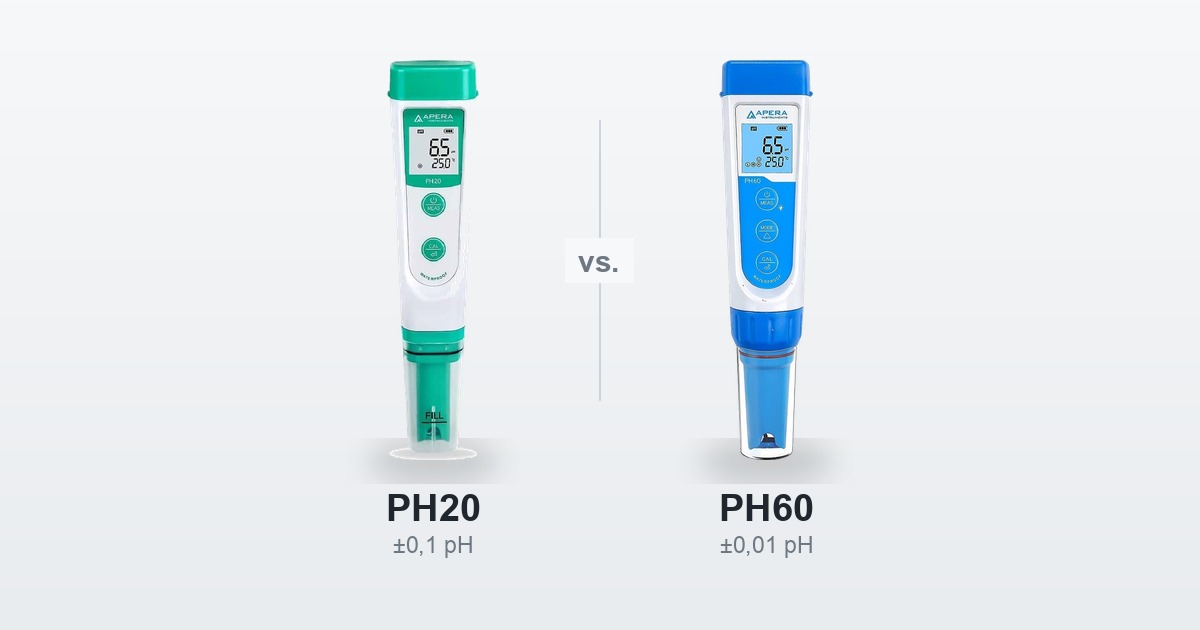
One reads to 0.1 pH, the other to 0.01. That sounds like an easy decision. It is not. The question is not which device measures more precisely, but whether you can do anything with that precision.
The difference in one sentence
The Apera PH20 Value pH pocket meter is a rugged entry level device with a built in electrode. The Apera PH60 Premium pH pocket meter reads one decimal place finer, covers a wider range and has a replaceable electrode, which means it can be repaired instead of replaced.
The specifications side by side
| PH20 Value | PH60 Premium | |
|---|---|---|
| pH range | 0.0 to 14.0 | −2.00 to 16.00 |
| Resolution | 0.1 pH | 0.01 pH |
| Accuracy | ±0.1 pH | ±0.01 pH |
| Electrode | built in | replaceable (PH60-E) |
| Calibration | 1 to 3 points, automatic buffer recognition | 1 to 3 points, automatic buffer recognition |
| Temperature | 0 to 50 °C, ATC | 0 to 50 °C, ATC |
| Protection | IP67, floats | IP67, floats |
| Power | 4 × AAA, up to 1,000 hours | 4 × AAA, up to 1,000 hours |
| Redox (ORP) | no | can be converted with an ORP electrode |
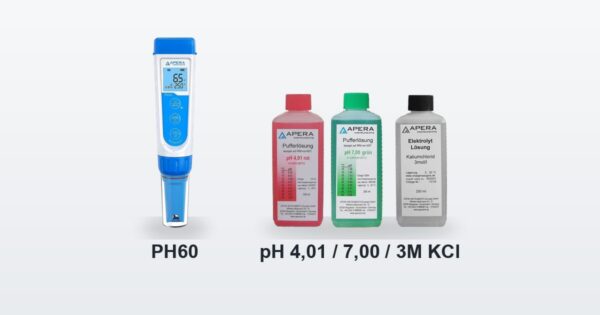
| In the box | buffers 4.00 and 7.00, batteries, case | buffers 4.00, 7.00 and 10.01, KCl storage solution, batteries, case |
What stands out is how much is identical: housing protection, temperature compensation, calibration logic and battery life. Buying the PH20 does not get you a stripped down device, it gets you the same operating concept with a coarser resolution and an electrode you cannot swap.
What 0.1 versus 0.01 means in practice
The optimal pH range in coco sits roughly between 5.8 and 6.2. That is four tenths of headroom. A device with 0.1 resolution shows you five steps inside that window: 5.8 / 5.9 / 6.0 / 6.1 / 6.2. That is plenty to see whether you are inside the window or sliding out of it. Which window applies to your substrate is covered in our guide to the optimal pH value.
The second decimal place only becomes valuable where you track changes rather than states: watching whether a recirculating solution drifts over the day, setting input against runoff, or dialling in a batch of nutrients reproducibly. There the difference between 6.04 and 6.11 is information. Rounded to 0.1 both read “6.1” and you see nothing at all.
An honest note on accuracy
±0.01 pH is the figure for the measuring electronics under ideal conditions. What actually lands in your cup also depends on the quality of your buffers, on temperature, on the state of the electrode and on how clean your sample is. A PH60 with old buffer solution measures worse than a freshly calibrated PH20. The display promises precision, but your working method has to deliver it. See our calibration guide for the details.
The real difference: the electrode
A pH electrode is a wear part. With good care it typically lasts one to two years. Apera gives six months of warranty on the electrode itself and two years on the device. When it reaches the end, the two devices part ways:
- PH20: built in electrode. When it is done, the device is done.
- PH60: unscrew the electrode, fit a new one, calibrate, finished. The Apera pH replacement electrode for PH60 (PH60-E) costs a fraction of the device price.
Over three or four years that turns the cost calculation around. Measure daily and the PH20 route means buying a new device every few years, while the PH60 route means buying an electrode. Check your runoff twice a month and the electrode will reach the end of its life through drying out rather than use, which makes the maths look different again.
-
Original price was: 124,95 €.112,95 €Current price is: 112,95 €.
Includes 19% MwSt.Free delivery to Germany for this product!Add to cart
The extended range: do you need it?
From −2.00 to 16.00 pH sounds impressive, but it is meaningless for growing: nutrient solution, tap water and runoff all live between 4 and 8. The range matters in cleaning technology, with strongly acidic or alkaline concentrates and in food processing. Do not buy the PH60 for its range, buy it for the resolution and the replaceable electrode.
What about ORP?
The PH60 can be converted to redox measurement with an ORP electrode. That is interesting if you keep an eye on water treatment, disinfection or the oxidation conditions in a nutrient solution. If you need redox permanently and alongside pH, you are better served by a dedicated device such as the Apera ORP60 Premium ORP pocket meter, or by the Apera PC60-Z Smart multi-parameter measuring device (with app), which combines pH, EC, TDS, salinity and temperature in one unit and sends the readings to an app.
The decision in three sentences
- ✅ Take the PH20 if you occasionally check whether your water or runoff sits in the right window. It is rugged, it floats, it calibrates automatically and it costs considerably less.
- ✅ Take the PH60 if you measure regularly, document trends, set input against runoff, or want to keep the device for years instead of binning it at the first electrode failure.
- ✅ Take the PC60-Z if you measure pH and EC anyway and have no appetite for two devices, two calibrations and two cases.
-
Original price was: 83,30 €.65,99 €Current price is: 65,99 €.
Includes 19% MwSt.plus shippingAdd to cart
What both devices need
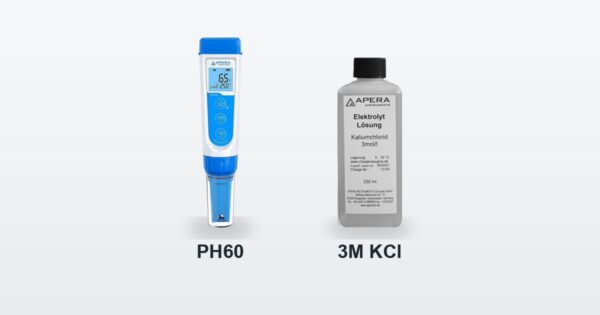
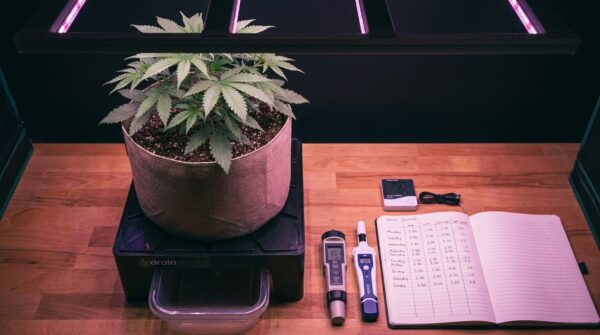
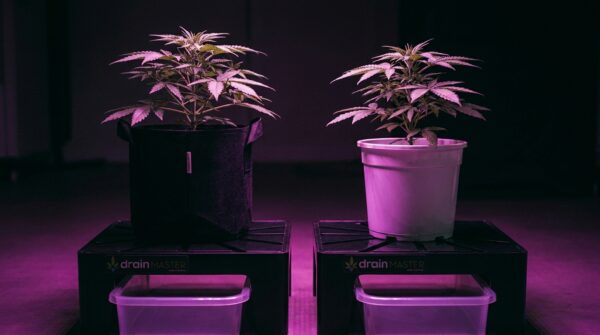
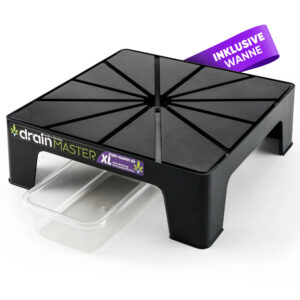
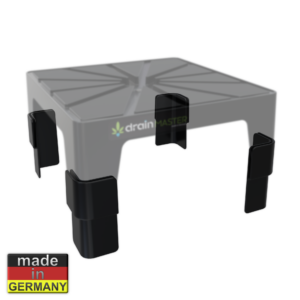
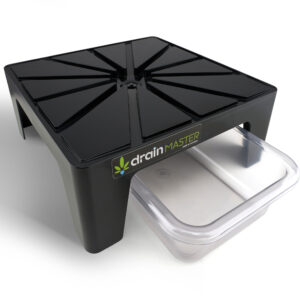
Whichever you choose: without fresh buffer solution and KCl storage solution even the more expensive device delivers numbers without value. Both are in the Apera pH calibration solution set. And without a clean sample even that is useless, because measuring from water that stood around means measuring evaporation residue and deposits. That is what the DrainMaster is for: it collects runoff cleanly, without you having to lift the pot.
How to turn those readings into decisions is covered in feeding cannabis correctly: how to read your runoff.